
I Went to Wales to Escape Work and AI. Instead, I Found the Man Who Showed Us a Bright Future for Both
This wasn’t the weekend I’d planned!!
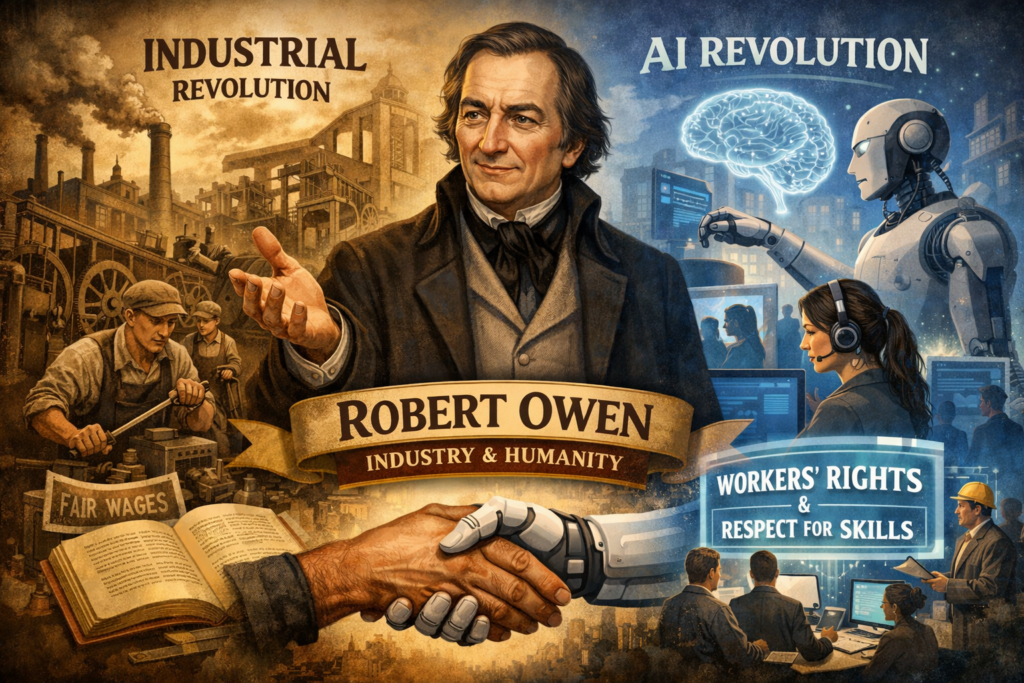
My wife and I decided to take a weekend break in Wales just prior to Christmas. Time to get away from it all including AI and the Future of Work. It was going really well until we started walking around Newtown – population about 11,000. A quiet market town in Powys, surrounded by lush green countryside – there was even a sheep auction going on next to where we parked our car. Perfect.
Walking along I saw the plaque on a building: Robert Owen, born here 1771. The name rang a bell, but I couldn’t quite place it.
Then it clicked. Some years back, I’d been chair of governors at a primary school. We’d been investigating joining the Co-operative Schools Trust. Robert Owen kept coming up in the materials. The “father of the co-operative movement.” Pioneer of worker welfare. That Robert Owen.
I’d accidentally stumbled into the birthplace of one of the Industrial Revolution’s most radical thinkers. A man who died right here in the Bear Hotel on 17 November 1858.
So much for escaping the future of work, I was bitten by the research bug, how had I missed this thread???
Wait, He Did WHAT?
Robert Owen was the sixth of seven children, his father was a saddler, ironmonger, and postmaster. His mother was from a respectable farming family. Initially he attended school locally. He was a precocious child, reading avidly and made a “teacher’s assistant” aged 7. But, aged 10 he started an apprenticeship in Stamford, Lincolnshire with a clothier. Not unusual for the time, but how his life unfolded was exceptional.
Here’s what Owen did in the early 1800s, flying in the face of all that was going on in the Industrial Revolution around him – by this time he owned a cotton mill in Lanark, Scotland:
When children routinely worked 13-14 hour days from age 5:
Owen refused to employ anyone under 10 (that was the age he started work). Not because there was a law (there wasn’t). Because he thought it was wrong.
For children under 10, he created Britain’s first infant school in 1817. Ages 3-10 could attend. No corporal punishment. No beatings. No fear-based learning.
The curriculum? Music, dancing, nature study, learning through play. The goal wasn’t to train them for factory work, it was “the formation of character,” helping them become better people.
Revolutionary concept: the kids should enjoy it.
When the standard working day was 14-16 hours:
Owen cut it to 10.5 hours, then 10 hours. Same pay.
In 1810, he proposed something truly radical: the eight-hour workday. He coined the slogan that would echo for the next two centuries:
“Eight hours labour, eight hours recreation, eight hours rest.”
Workers thought he was insane. Their bosses thought he’d go bankrupt.
When other mill owners treated workers as expendable machinery:
Owen built decent housing. Opened a village store selling quality goods at near-cost prices. Created a sick fund, essentially primitive health insurance when basic medical care was denied to most workers. Provided education not just for children, but for workers and their families.
When others were concentrating wealth and eroding workers’ rights he was trying to share the dividends – but still made a fortune:
New Lanark became the most profitable cotton mill in Britain. Royalty visited. Reformers from across Europe came to study his methods. The Tsar of Russia stopped by. Between 1799 and 1810, the mills generated £60,000 in profit whilst Owen was revolutionising how workers were treated.
Owen proved you could treat workers like humans AND get rich.
This takes some unpicking
He Wasn’t a Typical Wealthy Philanthropist
Owen wasn’t born rich. His father, Robert Owen Sr., was a saddler, ironmonger, and postmaster of Newtown. Skilled artisan class. Comfortable, but not wealthy.
This background is crucial because it explains what Owen understood that other factory owners didn’t: he came from the class that was being destroyed.
Here’s the thing about the Industrial Revolution that nobody teaches properly:
It wasn’t “poor people vs. rich people.”
It was “the skilled middle class being sidelined by technology so the capitalists could grow even wealthier.”
Before factories arrived:
- Skilled weavers earned £50-100 per year
- They owned their looms
- Worked at their own pace
- Had gardens, raised animals, supplemented their income
- Were their own bosses
- This was the middle class
After factories came:
- Those same skilled weavers became unskilled factory operatives
- Earning £25 per year, literally half as much
- Lost their tools, their homes, their autonomy
- Became wage labourers with no control
- Were pushed into poverty
The statistics tell the story. In 1700, about 80% of workers were skilled. By 1850, only 61% were. The middle class wasn’t rising; it was being hollowed out.
Owen’s father was a saddler, exactly the kind of skilled artisan whose world was being upended. Owen watched this happen. He understood what was at stake in a way that mill owners born into wealth never could.
The Boy Who Became a Teacher at Seven
Owen’s childhood shaped everything that came after. He was born on 14 May 1771, the sixth of seven children (two died young). His mother, Anne Williams, came from one of Newtown’s “respectable farming families” and was described as beautiful and “superior in mind and manner for her class.” His father managed not just his saddlery and ironmongery business but also the parish affairs, being better acquainted with local finances than anyone else in the town.
Young Robert was bright. Exceptionally so. He started school at age 4 at Newtown Hall, the home of Sir John Pryce. By age 7, his schoolmaster, William Thickens, made him a teacher’s assistant. A seven-year-old helping to teach the other children.
He was an avid reader, borrowing books from every educated home in Newtown. The whole town knew him. He was good at sports, dance, and music. But he later recalled something telling: he “disliked competition and prizes in sports, because it made the losers unhappy.”
Even as a child, Owen was thinking about how systems affected people’s feelings and behaviour.
There was something else about Newtown that may have planted seeds. In 1762, nine years before Owen was born, the town had established the “Newtown First Community Benefit Society.” Members paid subscriptions to receive sickness benefits, a pension at 60, and a free funeral. It existed for over 120 years. Owen grew up in a town that already had a tradition of mutual aid and collective welfare.
At age 8, he started helping at the Tilsley sisters’ draper’s shop after school. By age 9, he was a formal apprentice. At age 10, he did something remarkable: he asked his parents if he could leave Newtown to continue his apprenticeship in London, living with his older brother William.
His parents said yes.
Most 10-year-olds in 1781 didn’t leave home. But Owen was driven, curious, ambitious. He went to London briefly, then to Stamford in Lincolnshire for a proper four-year apprenticeship with a draper who had an excellent library.
Owen spent his time reading. Religious controversies in particular. By his teenage years, he’d concluded that all religions were fundamentally flawed and that religious divisions in society were wrong.
This was the boy who would grow up to create Britain’s first infant school where children learned through play instead of beatings. Who would reject the idea that character was fixed at birth, instead believing it was shaped by circumstances and environment. Who would think that making workers happy wasn’t just morally right, it was good business.
The seeds were there from the beginning.
The Luddites Were Right
This is why the Luddites, who everyone mocks as “anti-technology,” were actually skilled weavers fighting to stay middle class, not poor labourers resisting progress.
They tried negotiating first. They asked for minimum wages. They asked for labour standards. They asked for pensions for workers who’d given decades to the craft.
The factory owners refused. Why negotiate when you’re about to get obscenely rich?
So the weavers smashed the machines.
The government’s response? Made machine-breaking a capital offence. Death penalty for breaking a loom.
More British soldiers were deployed against the Luddites than were fighting Napoleon in Spain at the same time.
Owen saw all this and thought: “There has to be another way.”
From £100 to £60,000
Owen left Newtown at age 10 to become a draper’s apprentice in Stamford. By age 18, his brother William, an established saddler in London, loaned him £100 (about £22,000 in today’s money, roughly two years’ wages for a clerk).
This £100 was Owen’s seed capital. He used it to enter Manchester’s booming cotton business, making machinery, spinning cotton, learning every aspect of the trade.
By age 19, he was managing 500 workers at Peter Drinkwater’s mill in Manchester, earning £300 per year. Three times his startup loan in a single year.
Over the next eight years, Owen built capital and reputation. He formed partnerships. He made business trips to Glasgow. He was building towards something bigger.
In 1798, age 27, Owen visited New Lanark on a business trip. He’d met Caroline Dale “by chance” in Glasgow, and she suggested he visit her father’s cotton mills. Owen was impressed by three things: the business potential (it was Britain’s largest cotton mill), David Dale’s unusually humane treatment of workers, and Caroline herself.
Within a year, Owen had negotiated a deal that would change industrial history.
The Deal
Owen to David Dale: “I want to buy your mills and marry your daughter.”
Dale had a problem. Owen wasn’t Scottish. He wasn’t Church of Scotland. And he wasn’t rich enough to buy the mills outright.
But Owen made a pitch: “I’ll continue your humane policies. I’ll treat the workers well. Better than well.”
Dale agreed to seller financing (common now, revolutionary then):
- Purchase price: £60,000
- Payment terms: £3,000 per year for 20 years
- Owen’s business partners from the Chorlton Twist Company would fund the deal
- Owen’s personal share: roughly £6,000-7,000 (about 10% of the total)
30 September 1799: Owen married Caroline Dale.
1 January 1800: Owen took over New Lanark.
Here’s the business genius of this structure: it was essentially a leveraged buyout with seller financing. Owen only needed capital for his share. He could use the mill’s profits to pay for the mill itself. He had 20 years to pay, a massive time advantage.
And it worked spectacularly. The mills generated £60,000 in profit between 1799 and 1810, that’s an average of £5,454 per year. They were paying Dale £3,000 per year, leaving plenty for the partners whilst Owen implemented his reforms.
By 1813, the business value had nearly doubled from £60,000 to £114,100.
The mill paid for itself whilst funding Owen’s revolutionary worker policies.
This wasn’t a rich philanthropist doing charity. This was a bootstrap entrepreneur proving that ethical capitalism is not just possible, it’s profitable.
The Paradox
Every other mill owner looked at the Industrial Revolution and thought: “How do I maximise profit?”
Owen looked at it and thought: “How do I prevent the skilled middle class from being destroyed?”
His approach, which everyone said would bankrupt him, included:
Children should be educated, not exploited. Britain’s first infant school where learning happened through play, music, and discovery rather than beatings and rote memorisation.
Workers should have dignity, not just wages. Decent housing, fair prices at the village store, healthcare through a sick fund, and hours that allowed for something resembling a life.
You can be profitable AND humane. This was the truly radical claim. Everyone “knew” you could be rich OR ethical. Owen said: “Why not both?”
And he was right. For 25 years.
New Lanark became the most profitable cotton mill in Britain whilst also becoming an international model for how workers should be treated. Proof that ethical capitalism works.
But Owen didn’t stop there.
Two Experiments
Owen would run two grand experiments in his lifetime:
Experiment 1: New Lanark (1800-1825)
Treat workers well, share the productivity gains, invest in education and welfare, but maintain the connection between work and reward.
Result: 25 years of profitability. Changed how the world thought about workers’ rights. Proved it was possible.
Experiment 2: New Harmony, Indiana (1825-1827)
Using his wealth he tried a bold, utopian experiment in the USA. He tried to build a model society based on a communal model. Everyone shares the results equally regardless of contribution. Work becomes optional, rewards guaranteed.
We’ll come back to this in later posts, but the result: Collapsed in less than two years. Cost Owen £40,000, roughly 80% of his fortune. Key problems that will resonate today: governance clarity, free-riding accusations, mismatched expectations, and how to allocate unpleasant work.
Same man. Same values. Same genuine desire to help workers and create a better world.
Completely opposite results.
The Ghost in the Bear Hotel
Standing in Newtown, you can visit the Robert Owen museum and learn more about his life and legacy.
But here’s what strikes me: New Lanark still stands. It’s a UNESCO World Heritage Site. The mills, the workers’ housing, the Institute for the Formation of Character, the school, all still there. Physical proof that it worked.
New Harmony? Just a historic marker in Indiana commemorating a failed experiment, but one with vital lessons we need if we want to make AI a universal success.
I came to Wales to escape thinking about AI and the future of work. Instead, I found a man who’d already run the experiments we’re about to repeat.
We’re deploying AI at scale. We’re about to see massive productivity gains. We’re hearing the same promises about “high-skill, high-wage economies” that workers heard during the Industrial Revolution.
We’re also seeing the same pattern: technology threatening the skilled middle class. Last time it was weavers and artisans. This time it’s knowledge workers, software engineers, lawyers, writers, accountants, designers. The people who think they’re safe.
History suggests they shouldn’t be so confident.
But Owen showed us both paths forward. One worked for 25 years and made everyone richer. One failed in less than two years and destroyed his fortune, but might work today if we can learn from his mistakes.
The question isn’t whether ethical capitalism is possible in the age of AI. Owen proved it’s possible.
The question is whether we’re willing to choose it.
Next in this series: The £7,000 decision that changed everything. In 1806, when America cut off cotton exports and every other mill in Britain laid off their workers, Owen made a different choice. It was the best investment he ever made. And it shows us exactly what companies should do when AI disrupts their workforce.